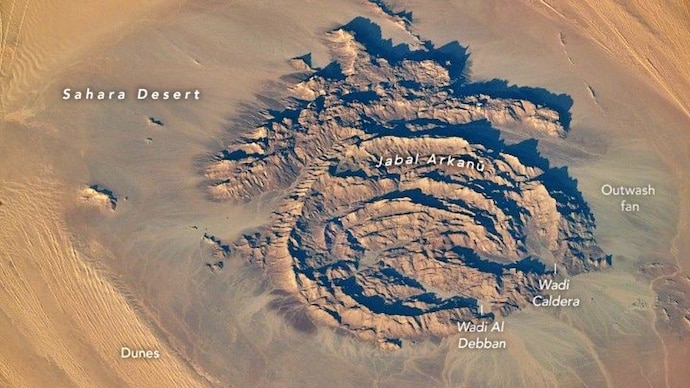
The Sahara Desert, the world’s largest hot desert, has always fascinated scientists, explorers, and travelers alike. Its vast stretches of sand, towering dunes, and rugged landscapes have hidden secrets that continue to intrigue humanity. On September 13, 2025, an astronaut aboard the International Space Station (ISS) captured a remarkable image showing mysterious rings of rock in the middle of the Sahara. The photograph, which quickly went viral on social media, reveals formations that have puzzled both scientists and desert enthusiasts.
The Photograph That Sparked Curiosity
The image, taken from the vantage point of space, displays circular rock formations casting long shadows across the arid landscape. Unlike typical sand dunes or rocky outcrops, these formations appear unusually symmetrical and evenly spaced, sparking questions about their origin. The photograph shows multiple concentric circles of rock, forming patterns that are rarely observed in natural desert terrain.
Astronauts often capture images of Earth as part of research programs, but this particular photograph stood out because of its geometric precision and striking visual appeal. Experts immediately began analyzing the image to understand whether these rings were natural formations, remnants of ancient civilizations, or the result of unknown geological processes.
bestcbdblogs.com | worldintrend.com | lifevesthealth.com
topcbdvapez.com | thetourismplace.com
Understanding the Sahara’s Geology
The Sahara Desert is not just an endless expanse of sand; it also features mountains, plateaus, rocky outcrops, and dry riverbeds. Over millions of years, climatic changes, wind erosion, and tectonic activity have shaped the landscape into what we see today. Some regions of the Sahara have ancient rock formations that date back over 500 million years. These rocks are often rich in minerals and exhibit fascinating patterns, including circular and oval shapes caused by erosion and sediment deposition.
However, what makes the rings in this photograph unusual is their distinct circular arrangement. While wind and water erosion can form random patterns and dunes, perfectly rounded rock rings are extremely rare in nature. Geologists suggest that such formations could occur due to volcanic activity, meteorite impacts, or underground mineral deposits. Each hypothesis carries its own implications for the history of the Sahara.
Possible Explanations for the Rings
Several scientific theories have emerged to explain the mysterious rock rings:
-
Meteorite Impact Craters
One of the leading theories is that these rings could be ancient meteorite impact sites. When a meteorite strikes the Earth, it can leave behind circular craters surrounded by raised rock formations. Over thousands or millions of years, sand and sediment partially fill these craters, leaving the distinctive ring patterns visible from above. If this is the case, these formations could provide valuable information about the history of meteorite impacts on Earth. -
Volcanic Origins
Another possibility is that the rings were formed by ancient volcanic activity. Some volcanic structures, such as calderas and lava domes, can create concentric circular patterns as magma cools and contracts. While the Sahara is not typically associated with active volcanoes today, volcanic activity millions of years ago could have shaped these formations. -
Geological Erosion
Natural erosion by wind, rain, and temperature fluctuations can sometimes produce circular patterns in rock formations. Known as inselbergs or pedestal rocks, these structures form when softer rock erodes faster than harder rock, leaving isolated circular or dome-like shapes. However, the size and symmetry of the rings captured in the photograph suggest that erosion alone may not explain their presence. -
Human or Ancient Civilization Influence
Some researchers have proposed that the rings could be the remnants of ancient human activity. In parts of the Sahara, prehistoric civilizations left behind circular stone structures for ceremonial, astronomical, or agricultural purposes. While most known structures are smaller and less visible from space, the possibility of a lost or undiscovered ancient site cannot be entirely ruled out.
The Role of Astronaut Photography
Astronauts aboard the ISS play a critical role in documenting Earth from space. Their photographs help scientists monitor climate change, deforestation, desertification, and natural disasters. In the case of the Sahara rings, the astronaut’s vantage point provides a unique perspective that cannot be achieved from ground level. The high-resolution image allows researchers to study the formations in detail, measure their dimensions, and compare them with known geological structures worldwide.
Space photography also serves as an important tool for public engagement. Stunning images of Earth from space captivate people’s imaginations, raise awareness about environmental issues, and inspire curiosity about natural phenomena. The Sahara rings photograph quickly gained attention on social media, drawing both scientific and popular interest.
Scientific Investigations Underway
Following the viral release of the photograph, several research teams have expressed interest in conducting on-site investigations. Ground surveys, drone imaging, and satellite data analysis could help determine the exact composition, age, and origin of the rings. Researchers aim to collect rock samples and conduct geochemical and radiometric analyses to better understand the formations.
If these formations turn out to be ancient impact craters, they could provide valuable insights into Earth’s geological history and the frequency of meteorite impacts. Alternatively, if they are remnants of human activity, they could redefine our understanding of prehistoric civilizations in the Sahara, suggesting that people inhabited or traveled across this harsh environment in ways not previously documented.
Public Fascination and Theories
The photograph has also sparked a range of speculative theories among the public. Social media users have suggested everything from alien activity to secret military installations. While these ideas are not scientifically supported, they demonstrate the human tendency to find patterns and stories in unusual phenomena. Mysteries like these also highlight the importance of space observation in uncovering hidden or overlooked aspects of our planet.
Educational institutions have used the photograph to teach students about geology, desert ecosystems, and space science. Discussions about the rings encourage critical thinking, scientific inquiry, and an appreciation for Earth’s complexity.
Implications for Future Research
The discovery of such unusual formations in the Sahara could have far-reaching implications:
-
Geological Mapping
Researchers may need to update geological maps of the Sahara to include these rings, enhancing our understanding of the region’s history and natural processes. -
Climate Studies
Understanding how these formations survived harsh desert conditions could provide clues about climate resilience and the evolution of desert ecosystems. -
Archaeological Exploration
If human influence is confirmed, archaeologists could uncover new evidence about ancient civilizations, trade routes, and cultural practices in the Sahara. -
Space Observation Techniques
This case emphasizes the value of astronaut photography and high-resolution imaging from space as tools for discovering new natural and historical features on Earth.
Conclusion
The mysterious rock rings captured by an astronaut over the Sahara Desert are more than just a visually striking image—they are a gateway to understanding Earth’s geological history, climatic changes, and possibly even ancient human activity. While scientists are still investigating their origin, the photograph has already inspired curiosity and wonder worldwide.
Whether these formations are the result of meteorite impacts, ancient volcanic activity, erosion, or human craftsmanship, they remind us of the vastness and complexity of our planet. As technology and space exploration advance, humans continue to gain new perspectives on Earth, discovering hidden secrets and marveling at natural wonders from an entirely new vantage point.
For now, the mysterious Sahara rings remain an enigmatic feature, waiting for researchers to unlock their full story, while captivating the imaginations of people across the globe.