Earth has been hit by one of the most powerful solar explosions in recent years, causing major disturbances to satellites, power systems, and even aircraft communication. The intense solar flare sent a surge of highly energetic protons toward the planet, powerful enough to penetrate deep into the atmosphere and reach ground level — a rare and alarming event that has scientists and space agencies on high alert.
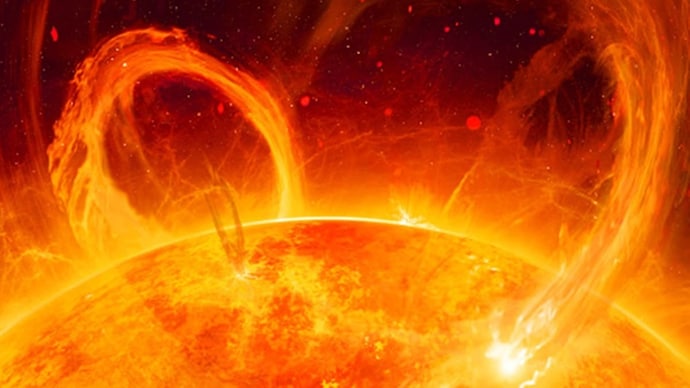 What Happened: The Solar Explosion Explained
The massive solar event, known as a solar flare or coronal mass ejection (CME), erupted from the Sun’s surface with incredible force. Solar flares are sudden bursts of radiation resulting from the release of magnetic energy stored in the Sun’s atmosphere.
In this case, the Sun unleashed a Class X flare, the most intense type of flare in the classification system. These flares can cause extreme disturbances in Earth’s magnetosphere, affecting everything from communication networks to power infrastructure.
Scientists reported that the flare expelled a dense cloud of charged particles — mostly protons and electrons — that began impacting Earth’s upper atmosphere within minutes. What’s concerning is that this particular wave of solar particles was so energetic that some managed to reach ground level, an event known as a Ground Level Enhancement (GLE).
uesource.com | luxuryescortservies.in | CrystalLyre.com
traveltipses.com | hiddeninlightphotography.com
Impact on Earth: Communication and Power Disruptions
The immediate effects of the solar storm have been widespread, though not catastrophic.
-
Satellites and GPS Systems:
Communication satellites and GPS navigation systems have experienced disruptions due to the sudden burst of radiation. Signals between satellites and Earth have become unstable, particularly near the poles, where the atmosphere is thinner and more vulnerable to solar activity. -
Aviation Disruptions:
Several commercial flights flying over the Arctic and high-latitude regions reported radio blackouts and communication delays with ground stations. Some airlines were forced to reroute flights to avoid regions with high radiation exposure. -
Power Grids and Ground Infrastructure:
Power companies in North America, Europe, and parts of Asia have been placed on high alert as strong geomagnetic storms can induce currents in long power lines, transformers, and pipelines. While no widespread blackouts have been reported yet, experts warn that if the geomagnetic storm strengthens, it could cause voltage fluctuations or transformer damage. -
Internet Connectivity:
The solar storm has also caused temporary internet and radio signal disruptions, particularly affecting satellite internet users. Some shortwave radio frequencies used by ships and aircraft became unusable for several hours.
How Solar Storms Affect the Planet
When a solar flare occurs, it releases electromagnetic radiation across the spectrum — from X-rays to radio waves. If it’s strong enough, this radiation can ionize the upper layers of Earth’s atmosphere, disrupting high-frequency radio waves used for communication.
Meanwhile, a coronal mass ejection (CME) can take several hours to days to reach Earth. When it does, the charged particles interact with Earth’s magnetic field, triggering geomagnetic storms. These storms are responsible for phenomena like the aurora borealis (northern lights) — but they can also damage satellites, interfere with navigation systems, and overload power grids.
In extreme cases, a massive CME could cause a planet-wide blackout, similar to what happened in 1989, when a powerful solar storm knocked out power in Quebec, Canada, for nine hours.
Scientists Monitor the Situation Closely
Space weather monitoring agencies, including NASA, NOAA’s Space Weather Prediction Center (SWPC), and ISRO’s Space Situational Awareness division, are continuously tracking the solar activity.
Experts have upgraded the current geomagnetic storm level to G4 (Severe) on a scale that ranges from G1 (Minor) to G5 (Extreme). A G4 storm is capable of causing widespread voltage issues, satellite anomalies, and auroras visible as far south as northern India and central United States.
Dr. David Hathaway, a solar physicist, said, “This is one of the strongest solar events we’ve seen in years. While Earth’s magnetic field protects us from most of the harmful radiation, our technology remains vulnerable.”
Auroras Light Up the Sky
One of the few beautiful outcomes of such solar activity is the spectacular aurora displays observed across the world.
People in countries such as Canada, Finland, Norway, and Russia have shared images of bright green and red lights filling the night sky. Reports have also come in from unexpected places like Germany, Scotland, and northern parts of India, where auroras are rarely visible.
These lights are created when solar particles collide with oxygen and nitrogen in Earth’s upper atmosphere, releasing energy in the form of glowing light.
The Science Behind Ground-Level Proton Events
The fact that this solar storm has caused protons to reach ground level makes it particularly noteworthy. Normally, Earth’s magnetic field and atmosphere block most solar radiation. However, in this case, the protons were energetic enough to bypass these natural shields.
Such Ground Level Enhancements (GLEs) are rare, occurring only a few times per solar cycle (which lasts about 11 years). When they happen, they can expose high-altitude flight crews, astronauts, and even passengers on polar routes to slightly increased levels of radiation.
Agencies have advised airlines to limit polar flights for the next 48 hours as a precaution.
What Experts Are Saying
Space weather experts have stressed that while the current event is serious, there is no cause for panic. Earth’s atmosphere continues to protect life on the surface from harmful radiation.
Dr. Priya Sharma, a space scientist, explained, “Solar storms like this remind us of how interconnected our planet is with the Sun. Our power systems, satellites, and even flights are all part of a global network influenced by space weather.”
She added that governments and industries need to invest in stronger space-weather forecasting systems to minimize future risks.
Preparing for the Future
This event has reignited discussions about solar preparedness — how nations can safeguard critical systems against future solar storms.
Some measures being discussed include:
-
Building radiation-hardened satellites that can resist solar interference.
-
Upgrading power grid infrastructure with magnetic shielding and surge protectors.
-
Training airline staff to handle in-flight communication losses.
-
Developing international space weather monitoring protocols.
The United Nations Office for Outer Space Affairs (UNOOSA) has also emphasized the importance of cooperation between countries to share real-time solar data and forecasts.
Conclusion
The recent solar explosion serves as a powerful reminder that while Earth may seem distant from the Sun’s fury, we remain deeply connected to its rhythms. The surge of solar energy that reached our planet this week has disrupted satellites, challenged power systems, and tested the resilience of our technology — but it has also illuminated the skies with breathtaking auroras.
As scientists continue to study and monitor solar activity, one thing is clear: the Sun’s immense power can both inspire and disrupt, reminding humanity of its place in the vast cosmic dance of the universe.