
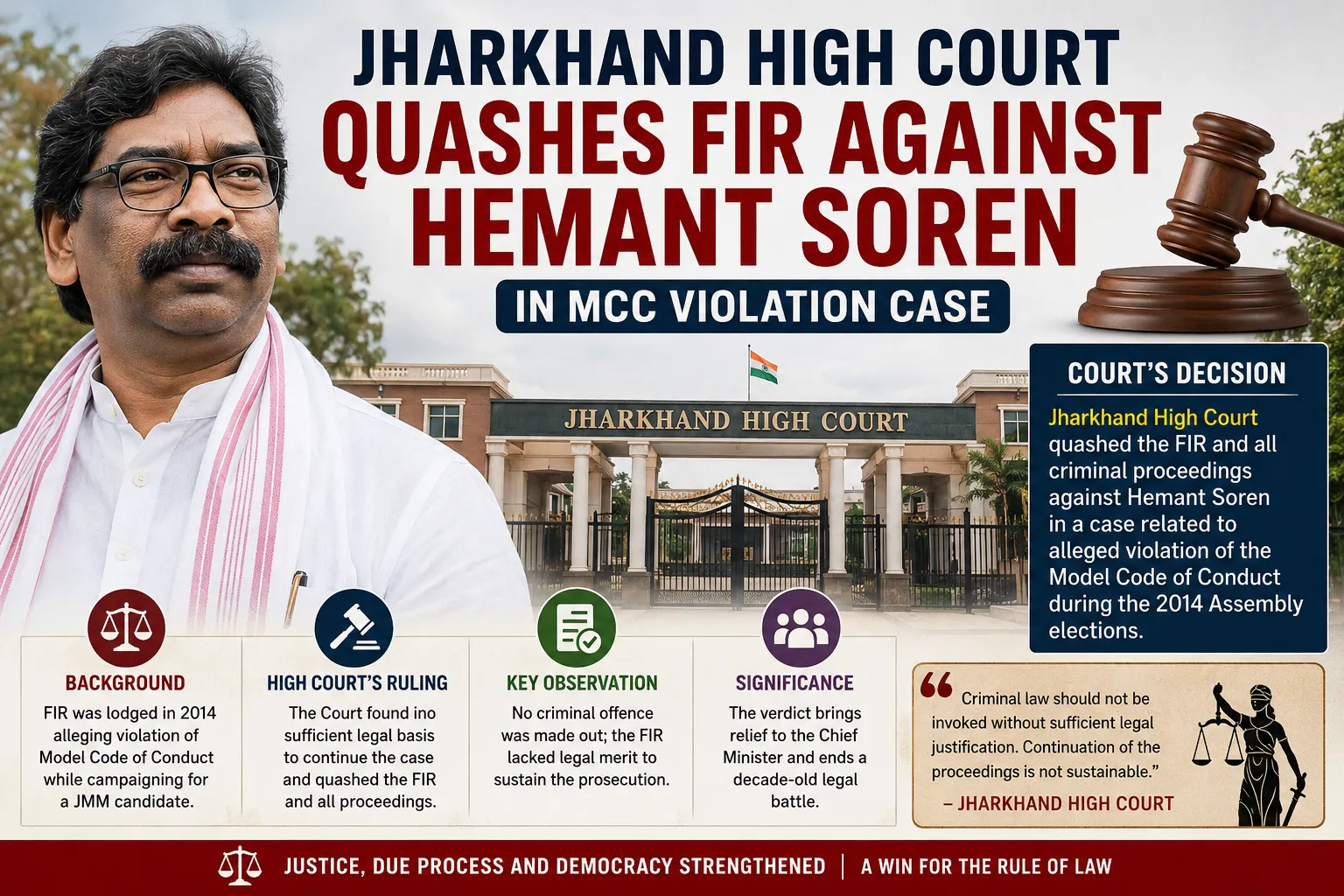
Jharkhand Chief Minister Hemant Soren has received significant legal relief after the Jharkhand High Court quashed a First Information Report (FIR) filed against him in connection with an alleged violation of the Model Code of Conduct (MCC) during the 2014 Jharkhand Assembly elections. The decision effectively brings an end to criminal proceedings that had remained pending for more than a decade.
The FIR, registered at the Adityapur police station in Seraikela-Kharsawan district, accused Soren of violating election rules while campaigning for a candidate of the Jharkhand Mukti Morcha (JMM). The High Court, after examining the records and hearing arguments from both sides, concluded that there were insufficient grounds to continue the criminal case and quashed the FIR.
The ruling has once again drawn attention to the legal framework governing election campaigns, the implementation of the Model Code of Conduct, and the judiciary’s role in reviewing criminal proceedings linked to electoral disputes.
Background of the Case
The case dates back to the 2014 Jharkhand Assembly elections. During the campaign period, an FIR was lodged against Hemant Soren, alleging that he violated provisions related to the Election Commission’s Model Code of Conduct while campaigning for a JMM candidate.
According to the allegations, Soren had continued campaigning beyond the permitted time prescribed under election guidelines. Based on these allegations, criminal proceedings were initiated, and the matter remained pending before a lower court for several years.
Subsequently, Soren approached the Jharkhand High Court, challenging the legality of the FIR and seeking the quashing of all proceedings arising from it.
High Court’s Decision
The Jharkhand High Court examined the petition in detail before delivering its judgment. Justice Anil Kumar Choudhary heard arguments presented by both the petitioner and the state government before allowing the criminal writ petition.
The court ultimately concluded that there was no sufficient legal basis to continue the prosecution. As a result, it quashed the FIR and all criminal proceedings connected to the case.
The judgment provides complete legal relief to Hemant Soren in relation to this particular matter and closes litigation that had continued for more than ten years.
Arguments Presented Before the Court
During the proceedings, Soren’s legal team argued that no violation of the Model Code of Conduct had actually taken place.
The defence maintained that the Chief Minister had merely participated in election campaigning for a candidate belonging to his political party and had not committed any criminal offence. It was further argued that the FIR lacked sufficient legal merit and should therefore be set aside.
The state government presented its submissions supporting the continuation of the proceedings. However, after reviewing the available records, documents, and legal arguments, the High Court found that continuing the criminal case was not justified.
Understanding the Model Code of Conduct
The Model Code of Conduct is a set of guidelines issued by the Election Commission of India to regulate the conduct of political parties, candidates, and governments during elections.
Its primary objective is to ensure free, fair, and transparent elections by promoting ethical campaigning and preventing misuse of official machinery.
The Code covers several areas, including campaign timings, public meetings, election speeches, advertisements, use of government resources, and conduct of political parties.
Although the Model Code itself is not a law enacted by Parliament, violations of certain provisions may attract legal action if they involve offences under existing statutes such as the Representation of the People Act or the Indian Penal Code.
Why Cases Related to Election Campaigns Matter
Election-related disputes are an important component of India’s democratic process.
Complaints involving campaign conduct, election expenditure, hate speech, or violation of election guidelines are examined carefully to preserve the integrity of elections.
At the same time, courts play an equally important role in ensuring that criminal proceedings are supported by sufficient legal evidence.
When courts determine that a prosecution lacks adequate legal foundation, they possess the authority to quash criminal proceedings in accordance with constitutional and statutory principles.
Such judicial oversight helps maintain the balance between electoral accountability and protection against unwarranted prosecution.
Judicial Review and Criminal Proceedings
The Indian judiciary has consistently emphasized that criminal law should not be invoked without sufficient legal justification.
High Courts possess inherent powers to quash criminal proceedings if they conclude that continuing a case would amount to misuse of the legal process or where essential ingredients of an alleged offence are absent.
These powers are exercised carefully after examining case records, legal submissions, and applicable laws.
In Hemant Soren’s case, the High Court concluded that continuation of the proceedings was not legally sustainable.
The judgment highlights the judiciary’s role in protecting both the fairness of criminal investigations and the rights of individuals facing prosecution.
Political Significance of the Verdict
The High Court’s decision comes at a politically significant time for Jharkhand.
As the state’s Chief Minister and a prominent leader of the Jharkhand Mukti Morcha, Hemant Soren has remained at the centre of several political and legal developments over recent years.
Although this judgment relates specifically to a decade-old election campaign case, it represents an important legal victory for the Chief Minister by removing one long-pending criminal proceeding.
Political observers note that decisions involving senior public leaders often attract considerable public attention because they intersect with governance, electoral politics, and public accountability.
However, it is equally important to distinguish between judicial findings in individual cases and broader political debates.
Election Laws and Democratic Accountability
India’s electoral system relies upon both administrative oversight by the Election Commission and judicial review by constitutional courts.
While election authorities monitor campaign conduct and investigate complaints during elections, courts ensure that any criminal proceedings comply with established legal principles.
This dual mechanism strengthens democratic accountability by combining regulatory supervision with judicial safeguards.
The system also allows public representatives to challenge actions they believe are legally unsustainable, ensuring that disputes are resolved through due process rather than political controversy.
Lessons from the Case
The case highlights several broader lessons regarding India’s legal and electoral framework.
First, election-related complaints may continue through the judicial system for many years before reaching final resolution.
Second, every criminal prosecution must ultimately withstand judicial scrutiny based on evidence and applicable law.
Third, the judiciary remains an essential institution for balancing enforcement of election norms with protection of individual legal rights.
Finally, the case illustrates the importance of due process in democratic governance, where allegations alone do not determine legal outcomes.
Looking Ahead
With the FIR now quashed, all criminal proceedings connected to the 2014 Model Code of Conduct case have come to an end.
While the judgment closes one chapter of litigation involving Hemant Soren, broader discussions regarding election law enforcement, campaign regulations, and judicial oversight are likely to continue.
Political parties across the country are increasingly aware of the importance of complying with election guidelines, while election authorities continue strengthening monitoring mechanisms during campaigns.
Courts will remain central to ensuring that disputes arising from elections are resolved fairly and according to law.
Conclusion
The Jharkhand High Court’s decision to quash the FIR against Chief Minister Hemant Soren marks the conclusion of a legal case that originated during the 2014 Assembly elections. After reviewing the evidence and hearing detailed legal arguments, the Court determined that there were insufficient grounds to continue the criminal proceedings, providing significant legal relief to the Chief Minister.
Beyond its immediate political significance, the judgment underscores the importance of judicial review in India’s democratic framework. It demonstrates how courts safeguard the rule of law by ensuring that criminal prosecutions meet legal standards while preserving the integrity of electoral processes. As India continues to strengthen its democratic institutions, such decisions reinforce the balance between accountability, fairness, and constitutional protections.
roystonhotel roystonhotel roystonhotel roystonhotel roystonhotel roystonhotel roystonhotel roystonhotel roystonhotel roystonhotel roystonhotel roystonhotel roystonhotel roystonhotel roystonhotel roystonhotel roystonhotel roystonhotel roystonhotel roystonhotel roystonhotel roystonhotel roystonhotel roystonhotel roystonhotel roystonhotel roystonhotel roystonhotel roystonhotel roystonhotel roystonhotel roystonhotel roystonhotel roystonhotel roystonhotel roystonhotel roystonhotel roystonhotel roystonhotel roystonhotel roystonhotel roystonhotel roystonhotel roystonhotel roystonhotel roystonhotel roystonhotel roystonhotel roystonhotel roystonhotel roystonhotel roystonhotel roystonhotel roystonhotel roystonhotel roystonhotel roystonhotel roystonhotel roystonhotel roystonhotel roystonhotel roystonhotel roystonhotel roystonhotel roystonhotel roystonhotel roystonhotel roystonhotel roystonhotel roystonhotel roystonhotel roystonhotel roystonhotel roystonhotel roystonhotel roystonhotel roystonhotel roystonhotel roystonhotel roystonhotel roystonhotel roystonhotel roystonhotel roystonhotel roystonhotel roystonhotel roystonhotel roystonhotel roystonhotel roystonhotel roystonhotel roystonhotel roystonhotel roystonhotel roystonhotel roystonhotel roystonhotel roystonhotel roystonhotel roystonhotel roystonhotel roystonhotel roystonhotel roystonhotel roystonhotel roystonhotel roystonhotel roystonhotel roystonhotel roystonhotel roystonhotel roystonhotel roystonhotel roystonhotel roystonhotel roystonhotel roystonhotel roystonhotel roystonhotel roystonhotel roystonhotel roystonhotel roystonhotel roystonhotel roystonhotel roystonhotel roystonhotel roystonhotel roystonhotel roystonhotel roystonhotel roystonhotel roystonhotel roystonhotel roystonhotel roystonhotel roystonhotel roystonhotel roystonhotel roystonhotel roystonhotel roystonhotel roystonhotel roystonhotel roystonhotel roystonhotel roystonhotel roystonhotel roystonhotel roystonhotel roystonhotel roystonhotel roystonhotel roystonhotel roystonhotel roystonhotel roystonhotel roystonhotel roystonhotel roystonhotel roystonhotel roystonhotel roystonhotel roystonhotel roystonhotel roystonhotel roystonhotel
