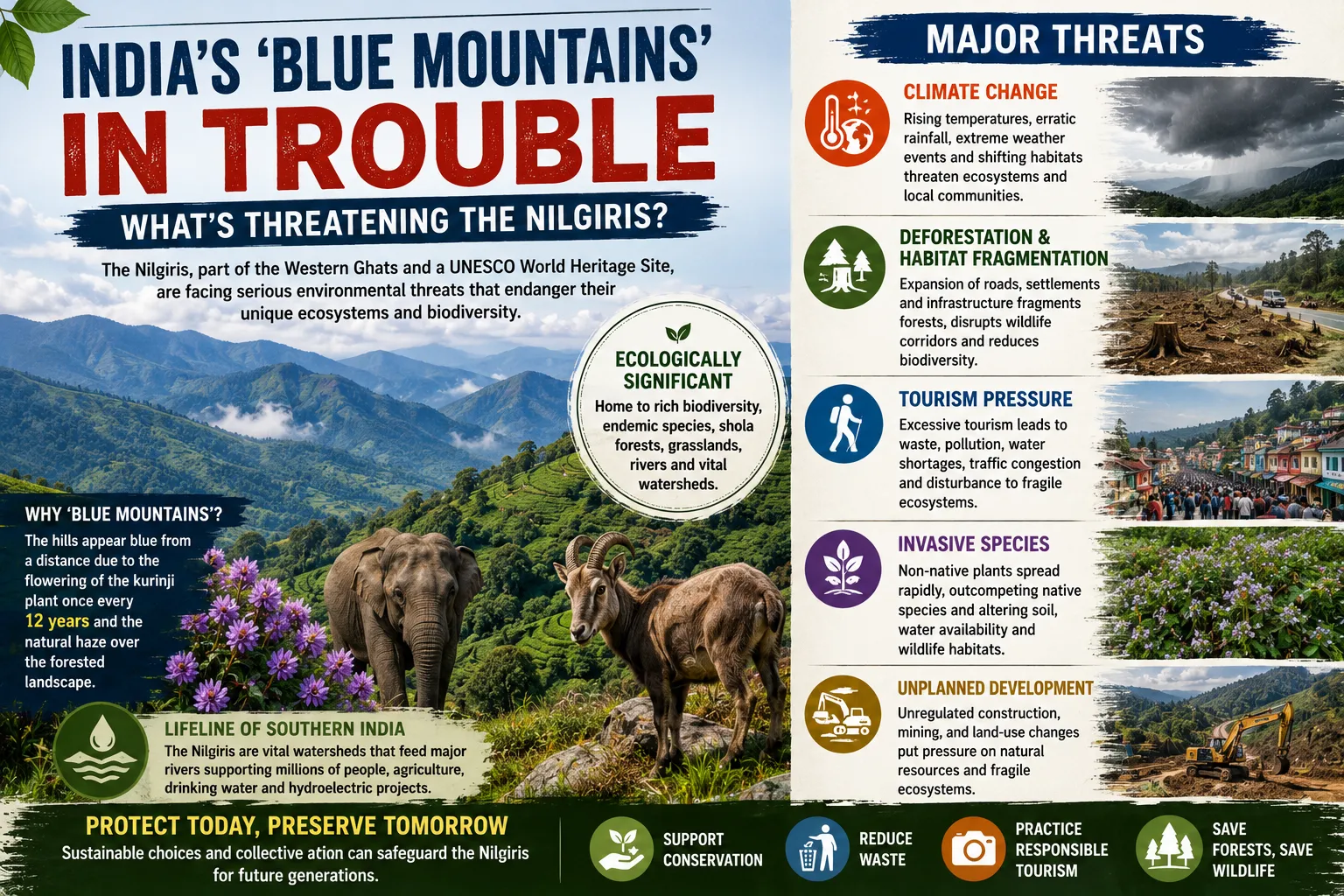
The Nilgiris, often referred to as India’s “Blue Mountains,” are among the country’s most treasured ecological landscapes. Located at the meeting point of Tamil Nadu, Kerala, and Karnataka, the Nilgiri Hills are renowned for their mist-covered peaks, rolling tea plantations, rich biodiversity, and pleasant climate. They form a crucial part of the Western Ghats, a globally recognized biodiversity hotspot and a UNESCO World Heritage Site.
However, behind the breathtaking scenery lies a growing environmental crisis. The Nilgiris are increasingly facing threats from climate change, unplanned urbanization, deforestation, tourism pressure, invasive species, and changing land-use patterns. These challenges are altering fragile ecosystems that have evolved over millions of years and are putting countless plant and animal species at risk.
As the world observes World Environment Day, the condition of the Nilgiris serves as an important reminder that protecting natural ecosystems requires collective responsibility, scientific planning, and sustainable development.
Why the Nilgiris Are Ecologically Significant
The Nilgiris occupy a unique geographical position where the Eastern and Western Ghats converge, creating one of India’s richest ecological regions. Their varied elevations and climatic conditions support an extraordinary range of habitats, including tropical forests, montane grasslands, shola forests, wetlands, rivers, and valleys.
The region is home to thousands of plant species, many of which are endemic and found nowhere else on Earth. It also provides habitat for several iconic wildlife species, including the Nilgiri tahr, Asian elephant, Bengal tiger, Indian gaur, leopard, lion-tailed macaque, Nilgiri langur, and numerous bird, butterfly, reptile, and amphibian species.
Beyond biodiversity, the Nilgiris play an essential role in maintaining ecological balance. They act as important watersheds, feeding several major rivers that support agriculture, drinking water supplies, and hydroelectric projects across southern India.
Why Are They Called the Blue Mountains?
The name “Blue Mountains” is believed to have originated from the bluish appearance of the hills when viewed from a distance. This effect is often attributed to the flowering of the native kurinji plant, which blooms once every twelve years in certain areas, along with the atmospheric haze created by the dense vegetation covering the mountains.
The unique landscape has long attracted nature lovers, photographers, researchers, and tourists from around the world.
Climate Change Is Reshaping the Landscape
Climate change has emerged as one of the most significant threats facing the Nilgiris.
Scientists have observed noticeable shifts in rainfall patterns, increasing temperatures, and more frequent extreme weather events across the Western Ghats. These changes are affecting both ecosystems and local communities.
Erratic rainfall has become increasingly common. Some years witness prolonged dry spells, while others experience unusually intense rainfall that triggers floods and landslides.
Rising temperatures are altering the habitats of many species adapted to cooler mountain climates. Plants and animals that depend on specific temperature ranges are finding it increasingly difficult to survive as climatic conditions continue to change.
These environmental shifts also affect agriculture, water availability, and the livelihoods of people living in the region.
Deforestation and Habitat Fragmentation
Although large portions of the Nilgiris remain protected, human activities continue to reduce natural habitats.
Expansion of roads, settlements, agriculture, infrastructure, and commercial development has fragmented forests into smaller patches.
Habitat fragmentation creates serious challenges for wildlife. Animals such as elephants and tigers require extensive forest corridors to move safely between habitats. When forests become divided by human development, wildlife movement becomes restricted, increasing the likelihood of human-wildlife conflict.
Fragmented forests also reduce genetic diversity by isolating animal populations, making them more vulnerable to disease and environmental changes.
Tourism Brings Both Opportunities and Challenges
The Nilgiris are among India’s most popular hill destinations.
Towns such as Ooty, Coonoor, and Kotagiri welcome millions of visitors every year, contributing significantly to the local economy through hospitality, transportation, and tourism-related businesses.
However, rapid growth in tourism has also placed considerable pressure on natural resources.
Increasing visitor numbers contribute to:
-
Higher waste generation
-
Traffic congestion
-
Water shortages
-
Construction of hotels and resorts
-
Noise pollution
-
Disturbance to wildlife habitats
Without careful planning, excessive tourism can gradually erode the very landscapes that attract visitors in the first place.
Promoting responsible tourism practices has become increasingly important for preserving the ecological integrity of the region.
Invasive Species Threaten Native Ecosystems
Another major environmental challenge facing the Nilgiris is the spread of invasive plant species.
Certain non-native plants introduced decades ago for forestry, ornamental landscaping, or commercial purposes have expanded rapidly across the landscape.
These invasive species often outcompete native vegetation, reducing biodiversity and altering soil conditions, water availability, and wildlife habitats.
The replacement of native grasslands and shola forests with invasive vegetation affects numerous species that depend on these unique ecosystems for food and shelter.
Conservation experts continue to emphasize the importance of restoring native habitats through scientific management and ecological restoration programs.
Pressure on Water Resources
The Nilgiris serve as the source of several rivers and streams that sustain millions of people downstream.
However, changing rainfall patterns, land degradation, deforestation, and increasing water demand have placed these water resources under stress.
Wetlands, streams, and natural springs play an essential role in regulating water flow throughout the year. Their degradation reduces the landscape’s ability to store water during rainy seasons and release it gradually during dry periods.
Protecting these natural water systems is critical not only for biodiversity but also for long-term water security across southern India.
Human-Wildlife Conflict Is Increasing
As forests shrink and human settlements expand, encounters between wildlife and local communities have become more frequent.
Elephants searching for food may enter agricultural fields, while predators occasionally venture near villages in search of prey.
Such conflicts create challenges for both conservation efforts and local livelihoods.
Effective wildlife management requires maintaining ecological corridors that allow animals to move naturally between forest habitats while minimizing interactions with human populations.
Community participation remains essential in developing sustainable solutions that benefit both people and wildlife.
Conservation Efforts Offer Hope
Despite the challenges, numerous organizations, researchers, forest departments, and local communities continue working to protect the Nilgiris.
Conservation initiatives include habitat restoration, anti-poaching measures, wildlife monitoring, invasive species management, watershed protection, and community-based conservation programs.
Scientific research also plays an important role in understanding changing ecological conditions and developing effective conservation strategies.
Environmental education programs have helped increase awareness among local residents, students, and visitors about the importance of preserving the Nilgiris’ unique ecosystems.
The Role of Sustainable Development
Protecting the Nilgiris does not mean preventing development altogether.
Instead, experts advocate for sustainable development that balances economic growth with environmental conservation.
This includes better urban planning, environmentally responsible tourism, improved waste management, stricter environmental regulations, restoration of degraded habitats, and careful assessment of new infrastructure projects.
Development decisions that consider ecological impacts can help preserve biodiversity while supporting local communities and economic opportunities.
What Individuals Can Do
Every individual can contribute to protecting fragile mountain ecosystems.
Responsible travel practices, reducing plastic waste, respecting wildlife habitats, conserving water, supporting eco-friendly tourism operators, and participating in environmental awareness initiatives all make a meaningful difference.
Small actions by millions of visitors can collectively reduce environmental pressure on sensitive ecosystems like the Nilgiris.
Public awareness also encourages policymakers and institutions to prioritize long-term environmental protection.
Conclusion
The Nilgiris represent far more than a scenic hill destination. They are one of India’s most valuable ecological treasures, supporting extraordinary biodiversity, providing vital water resources, and preserving unique natural heritage. Yet these “Blue Mountains” are increasingly threatened by climate change, habitat loss, invasive species, expanding tourism, and unsustainable human activities.
Protecting the Nilgiris requires coordinated efforts involving governments, scientists, local communities, conservation organizations, and responsible citizens. Sustainable development, scientific conservation, and environmental awareness must work together to ensure that future generations inherit the same vibrant forests, diverse wildlife, and breathtaking landscapes that have made the Nilgiris one of India’s most remarkable natural wonders.
On World Environment Day, the challenges facing the Nilgiris remind us that conserving nature is not only about protecting wildlife—it is about safeguarding ecosystems that sustain life, livelihoods, and the environmental balance upon which humanity itself depends.
roystonhotel roystonhotel roystonhotel roystonhotel roystonhotel roystonhotel roystonhotel roystonhotel roystonhotel roystonhotel roystonhotel roystonhotel roystonhotel roystonhotel roystonhotel roystonhotel roystonhotel roystonhotel roystonhotel roystonhotel roystonhotel roystonhotel roystonhotel roystonhotel roystonhotel roystonhotel roystonhotel roystonhotel roystonhotel roystonhotel roystonhotel roystonhotel roystonhotel roystonhotel roystonhotel roystonhotel roystonhotel roystonhotel roystonhotel roystonhotel roystonhotel roystonhotel roystonhotel roystonhotel roystonhotel roystonhotel roystonhotel roystonhotel roystonhotel roystonhotel roystonhotel roystonhotel roystonhotel roystonhotel roystonhotel roystonhotel roystonhotel roystonhotel roystonhotel roystonhotel roystonhotel roystonhotel roystonhotel roystonhotel roystonhotel roystonhotel roystonhotel roystonhotel roystonhotel roystonhotel roystonhotel roystonhotel roystonhotel roystonhotel roystonhotel roystonhotel roystonhotel roystonhotel roystonhotel roystonhotel roystonhotel roystonhotel roystonhotel roystonhotel roystonhotel roystonhotel roystonhotel roystonhotel roystonhotel roystonhotel roystonhotel roystonhotel roystonhotel roystonhotel roystonhotel roystonhotel roystonhotel roystonhotel roystonhotel roystonhotel roystonhotel roystonhotel roystonhotel roystonhotel roystonhotel roystonhotel roystonhotel roystonhotel roystonhotel roystonhotel roystonhotel roystonhotel roystonhotel roystonhotel roystonhotel roystonhotel roystonhotel roystonhotel roystonhotel roystonhotel roystonhotel roystonhotel roystonhotel roystonhotel roystonhotel roystonhotel roystonhotel roystonhotel roystonhotel roystonhotel roystonhotel roystonhotel roystonhotel roystonhotel roystonhotel roystonhotel roystonhotel roystonhotel roystonhotel roystonhotel roystonhotel roystonhotel roystonhotel roystonhotel roystonhotel roystonhotel roystonhotel roystonhotel roystonhotel roystonhotel roystonhotel roystonhotel roystonhotel roystonhotel roystonhotel roystonhotel roystonhotel roystonhotel roystonhotel roystonhotel roystonhotel roystonhotel roystonhotel roystonhotel roystonhotel roystonhotel roystonhotel